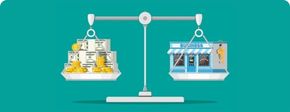
You can be profitable and still be bankrupt. You must closely plan and monitor your cash flow to be successful and stay in business.
During the current 2008 financial crisis, even the largest corporations have had to face this truth, and more than a few have suffered the consequences.
Tim Berry, president and founder of Palo Alto Software, has been expounding this principle for years. Managing cash flow has been a key feature of Business Plan Pro, Palo Alto Software’s industry-leading business-planning software.
Unfortunately, for millions of small- and medium-sized businesses, there is no Congressional bailout or rescue plan if you run your checking and savings accounts down to $0 while still owing money. Says Berry in his book, Hurdle: the Book on Business Planning, “Although cash is critical, people think in terms of profits instead of cash. We all do. When you and your friends imagine a new business, you think of what it would cost to make the product, what you could sell it for, and what the profits per unit might be. We are trained to think of business as sales minus costs and expenses, which results in profits.
Unfortunately, we don’t spend the profits in a business. We spend cash. Profitable companies go broke because they had all their money tied up in assets and couldn’t pay their expenses. Working capital is critical to business health. Unfortunately, we don’t see the cash implications as clearly as we should, which is one of the best reasons for proper business planning. We have to manage cash, as well as profits.”
When, as now, the financial industry is threatened with huge amounts of non-collectible debt, banks and investors are loath to lend out any new money. Credit becomes as scarce as the Rhode Island Red’s dentures (hen’s teeth ;-D ). Then you really have to watch your cash flow.
Say you manufacture a product and sell it to a distributor who sells it to a chain of stores which warehouses it before sending it to a franchise retailer, where it goes onto the shelf to wait for a customer to buy it. Now, when there is a credit crunch, the customer may wait to buy or not buy at all.
The product sits on the store shelf gathering dust, and the retail franchise can’t pay for the product that hasn’t sold. The warehouse is then slow to pay the distributor, and the distributor lets the net-30-day invoice to you, the manufacturer, slide to 45 days or even 60 days. You can see the accumulating cash shortage for everyone involved. Of course, as the manufacturer, it impacts you the most.
Now you have your own bills to pay, and have a big accounts receivable, but no money in your checking account to pay the electric company, your materials supplier, your employees, the IRS, or yourself.
In years past, in this situation you simply went to your bank and asked for a short-term Line of Credit. But now, the bank has clammed up. They might have limited lending. They might have made lending requirements more strict. They might have closed, seized overnight by the Feds, for insolvency. They might have been gobbled up by another megabank, at fire-sale prices.
So instead of a quick fix you are faced with your cash flowing out, but only trickling in.
So what’s a business owner to do? Revise your business plan. Envision the worst-case scenarios. Think about the steps you’d take to survive. There’s no need to produce a new full-blown plan. Do just the planning you need at this important juncture: sales, expenses, profit and loss, and the cash flow. In his new book, Plan-As-You-Go Business Planning Tim Berry makes the point that “Things change fast. Planning needs to be quick and flexible and sensitive to changing assumptions. You do the planning that you need when you need it.”

Look at the financial tables in your planning software, and try a few what-if projections on those worst cases. Your foremost concerns are scenarios where your cash flow depletes your accounts and reserves and you are out of money. If that eventuality arises from your what-if projections now is the time to seek funding, or loans, or lines-of-credit or investors. Waiting until the last minute, hoping that somehow the worst won’t come can guarantee your demise. In a credit crunch, lenders and investors are extremely wary of those seeking desperate emergency deals ($700 billion Federal bailouts notwithstanding).
But, if you approach the various funding sources in advance of need, with your revised plan in hand, you have the breathing space to negotiate the deal from a position showing forethought and responsibility.
And, of course, if your more optimistic projections prevail, and your cash flow stays healthy and positive, you need not actually take that loan or Line of Credit. Just knowing that your cash flow is backed up by prior planning and forecasting allows you to better manage your operations. As one financial manager once told me, “You have to plan your emergencies in advance.”
| Did you find this article interesting and helpful? Check out more articles, tips, blogs and special offers we will be adding during Global Entrepreneurship Week to help you take your business back to the fundamentals |


{ 1 trackback }
{ 1 comment… read it below or add one }
I’m amazed at how many businesses have to have credit to make payroll. that is just insane. Our online cleaning business start up website has so little overhead and such explosive growth that we have tons of business cash and still I make sure I keep those cash reserves at a certain level before I reinvest in business growth.